Terraform Modules That Actually Scale: Proven Enterprise Patterns

Terraform makes infrastructure provisioning repeatable, predictable, and easier to automate. At first, a few configuration files may handle everything your team needs. You create a virtual network, launch some compute instances, configure security groups, and deploy an application. Everything works, and your repository remains easy to understand.
However, enterprise environments rarely stay small. Soon, multiple teams need different environments, business units deploy across several cloud accounts, and production infrastructure requires stricter controls than development. Suddenly, the same networking configuration appears in ten repositories, security settings differ between environments, and even a small infrastructure update requires changes in multiple places.
This is where Terraform modules become essential. A module packages related resources, inputs, outputs, and configuration into a reusable unit. Instead of copying infrastructure code between projects, teams consume a shared implementation that follows agreed standards.
Nevertheless, reusability alone does not guarantee scalability. A poorly designed module can become a dependency that blocks every team, while an oversized module can turn a simple change into a risky infrastructure migration. Therefore, enterprise module design must balance reuse, flexibility, security, and independent team ownership.
The goal is not to create the fewest Terraform files possible. Instead, build modules that make the right infrastructure decision easy, keep changes predictable, and allow many teams to work without constantly coordinating every implementation detail.
Start With the Right Building Blocks: Design Modules Around Responsibilities
One of the most common Terraform mistakes is creating modules based on the number of resources rather than their purpose. For example, wrapping a single security group in a module does not automatically provide meaningful reuse. Similarly, combining an entire application platform into one enormous module can make maintenance difficult.
Instead, design modules around a clear infrastructure responsibility. A networking module might create a virtual network, subnets, route tables, and related network configuration. A database module might provision a managed database, configure encryption, and expose connection metadata without revealing credentials.
A good module has a clear answer to three questions:
- What does it own? Define the infrastructure resources it creates and manages.
- What can callers configure? Expose meaningful inputs without requiring callers to understand every internal detail.
- What does it guarantee? Document security defaults, expected behavior, outputs, and limitations.
Consider this example structure
terraform-modules/
├── networking/
│   ├── main.tf
│   ├── variables.tf
│   ├── outputs.tf
│   ├── versions.tf
│   └── README.md
├── compute/
│   ├── main.tf
│   ├── variables.tf
│   ├── outputs.tf
│   ├── versions.tf
│   └── README.md
├── database/
│   ├── main.tf
│   ├── variables.tf
│   ├── outputs.tf
│   ├── versions.tf
│   └── README.md
└── application-platform/
    ├── main.tf
    ├── variables.tf
    └── outputs.tf
Here, the networking, compute, and database modules provide reusable capabilities. Meanwhile, the application-platform module can combine those capabilities into a higher-level solution for a particular workload.
Importantly, do not split every resource into its own module just because Terraform supports modules. A module introduces an interface, versioning decisions, documentation, and testing requirements. Create one when it establishes a useful boundary, not simply because a file looks crowded.
The Golden Rule: Build Small Modules, Then Compose Bigger Solutions
A scalable enterprise architecture separates foundational capabilities from workload-specific implementations. This approach lets teams reuse stable building blocks while assembling different solutions for different applications.
For example, a cloud platform team might maintain modules for networking, identity, compute, databases, and monitoring. Application teams can then compose those modules into a deployment that meets their requirements. A data-processing workload may need private networking and managed compute, while an internal API may require a load balancer, container service, and database.
The following example demonstrates composition
module "network" {
  source  = "app.terraform.io/acme/network/aws"
  version = "2.3.0"

  environment = var.environment
  cidr_block  = var.vpc_cidr
}

module "application" {
  source  = "app.terraform.io/acme/application/aws"
  version = "1.8.0"

  environment   = var.environment
  network_id    = module.network.vpc_id
  private_subnets = module.network.private_subnet_ids
}
This configuration assumes that the referenced modules publish the specified versions and expose the shown inputs and outputs. Adapt the source addresses and interface names to your actual registry.
Notice the separation of responsibilities. The network module owns the network resources, while the application module consumes network outputs. Consequently, the application does not need to recreate networking resources or know how the network module implements them internally.
However, composition requires discipline. Avoid building deep dependency chains where one module indirectly controls dozens of unrelated resources. Keep dependencies explicit, outputs focused, and ownership boundaries easy to understand.
A useful enterprise principle is to compose stable modules into solutions rather than turn every solution into a universal module. This keeps the foundation reusable without forcing every workload into the same rigid design.
The Module Contract: Make Inputs Predictable and Defaults Safe
A module's interface determines how easy it is to adopt and maintain. If callers must understand dozens of obscure variables, they may avoid the module or configure it incorrectly. On the other hand, an interface with too few meaningful controls can prevent legitimate use cases.
Therefore, expose business-relevant settings instead of every underlying provider argument. For example, an application module might accept environment, instance_type, enable_monitoring, and allowed_ingress_cidrs. Callers should not need to understand every resource-level detail unless they genuinely need that control.
Terraform variable validation helps enforce contracts.
variable "environment" {
  description = "Deployment environment."
  type        = string

  validation {
    condition = contains(
      ["dev", "staging", "prod"],
      var.environment
    )

    error_message = "Environment must be dev, staging, or prod."
  }
}

variable "enable_encryption" {
  description = "Enable encryption for supported resources."
  type        = bool
  default     = true
}
This example validates the environment name and enables encryption by default. In a real module, also verify that encryption is supported and correctly configured for each resource.
Use safe defaults for security-sensitive settings, but do not assume that every default should be the same everywhere. A development environment may allow smaller compute resources, while production requires stricter availability, backup, and recovery settings.
Furthermore, use Terraform's type system to prevent accidental misconfiguration. Prefer structured objects for related settings rather than a long collection of loosely related strings. Add validation for supported values, meaningful error messages, and clear descriptions.
Finally, treat a module interface like a public API. Renaming an input, changing its type, or modifying its default can affect many consumers. Review interface changes carefully and document migration requirements before publishing a new major version.
The Enterprise Module Registry: One Trusted Source, Many Teams
As an organization grows, storing reusable modules in individual application repositories creates duplication and confusion. Teams may fork the same module, apply different fixes, and gradually drift away from the original implementation.
A centralized module registry provides a discoverable source of approved modules. Teams can find supported networking, identity, database, Kubernetes, and observability modules, along with their documentation and release history.
Terraform supports private module registries, including the Terraform Cloud and HCP Terraform registry capabilities, as well as private registries in other platforms. Organizations can also distribute modules through versioned Git repositories when a dedicated registry is not available.
A registry should provide more than a list of source addresses. For each module, publish:
- A clear purpose and supported use cases.
- Required Terraform and provider versions.
- Input and output documentation.
- Example configurations.
- Security and compliance expectations.
- Release notes and upgrade instructions.
- Ownership information and support expectations. For instance, an enterprise might publish network/aws, database/postgres, and kubernetes/cluster as independently versioned modules. Each team can then select compatible versions without copying implementation code into its own repository.
However, centralization should not create a single team that must manually approve every small infrastructure change. Establish ownership and automated quality gates, then let teams consume approved versions independently.
The platform team should maintain the paved road, not become a permanent ticket queue. In practice, a well-managed registry reduces duplicated effort while preserving team autonomy.
Versioning Without Fear: Give Every Module a Safe Upgrade Path
reusable module is only useful if consumers can upgrade it predictably. Without versioning, a change intended for one project can unexpectedly alter infrastructure in another. This risk becomes significant when dozens or hundreds of deployments consume shared modules.
Use semantic versioning where practical:
- Patch release: Fixes that preserve the public interface and intended behavior.
- Minor release: Backward-compatible features and additional optional inputs.
- Major release: Breaking changes that require consumer review or migration. For example, a module version might progress from 1.4.0 to 1.5.0 when it introduces a backward-compatible optional feature. If a later release renames a required input or removes an output, publish a new major version and explain the migration.
Consumers should pin module versions rather than relying on a moving branch. For registry modules, use an explicit version constraint, such as.
module "network" {
  source  = "app.terraform.io/acme/network/aws"
  version = "2.3.0"

  environment = var.environment
}
For Git-sourced modules, use a stable release tag or immutable commit reference instead of depending on the latest branch state. Registry module versions and provider lock files solve different problems, so manage both deliberately.
Additionally, avoid releasing untested module changes directly into production. Publish a candidate version, test it in representative environments, review the resulting plan, and then promote it through a controlled rollout.
A dependable upgrade process gives teams confidence that they can adopt improvements without taking unnecessary risks. Ultimately, predictable upgrades matter more than publishing new versions frequently.
The Environment Strategy: Stop Copying Development Into Production
Many Terraform repositories begin with separate directories for development, staging, and production. That structure can work well, but it becomes troublesome when teams duplicate the same resource definitions across environments.
A better approach is to reuse modules and maintain separate environment-specific configurations. Each environment can supply its own values, account identifiers, network ranges, capacity settings, and policy requirements.
For example.
environments/
├── dev/
│   ├── main.tf
│   └── terraform.tfvars
├── staging/
│   ├── main.tf
│   └── terraform.tfvars
└── prod/
    ├── main.tf
    └── terraform.tfvars
Each configuration can call the same module version while providing different values. As a result, development and production follow the same architectural patterns without sharing the same state or blindly using identical settings.
Nevertheless, separate environments should not become a reason to copy every configuration file. Where appropriate, use shared root-module composition, a consistent repository template, or a carefully maintained orchestration layer.
For larger organizations, separate cloud accounts or subscriptions often provide stronger isolation than relying solely on workspace names. Keep production permissions, credentials, and state access separate from lower environments.
The most important rule is to reuse implementation while isolating environment ownership and state. This gives teams consistent infrastructure without making a development mistake automatically affect production.
State Management: Keep the Foundation Strong Before Scaling Out
Terraform state maps configuration to real infrastructure. When several teams manage resources independently, state boundaries become critical because state determines which resources a Terraform operation can modify.
A single state file for an entire enterprise may look convenient at first. However, it can create large plans, longer operations, unnecessary coupling, and a broad blast radius. A small change to one application might interact with unrelated infrastructure.
At the other extreme, creating a separate state file for every tiny resource can create excessive operational overhead. Teams must manage many backends, permissions, dependencies, and deployment pipelines.
Instead, define state boundaries around ownership, lifecycle, and failure domains. A foundational networking stack might use one state, while an application platform uses another. A shared data platform may have its own state because it has different owners and change controls.
For example, an organization could use this structure:
state boundaries
├── organization-foundation
├── network-production
├── shared-security
├── application-platform-a
└── application-platform-b
Use a supported remote backend with access controls, encryption, and state locking where available. For AWS, an S3 backend can use native locking through use_lockfile in supported Terraform versions. Confirm your version and backend configuration before adopting a specific locking approach.
Also, never treat state as ordinary source code. It can contain sensitive values, even when Terraform marks some outputs as sensitive. Restrict access, protect state history, and establish recovery procedures.
Finally, avoid letting multiple independent root configurations manage the same resource. Clear ownership prevents competing plans and makes infrastructure changes easier to reason about.
Security by Design: Bake Guardrails Into Every Reusable Module
Enterprise infrastructure modules should make secure configurations the easiest configurations to deploy. If security depends on every developer remembering a long checklist, the organization will eventually experience inconsistent results.
Start by enabling secure defaults where appropriate. For example, database modules should support encryption, private connectivity, and backup configuration. Storage modules should avoid public access unless a documented use case requires it. Compute modules should encourage least-privilege identities and approved network boundaries.
Next, use validation and policy checks to catch unsafe configurations before deployment. Static analysis tools such as Checkov, Trivy, and Terrascan can help identify common infrastructure misconfigurations. Terraform-native policy frameworks or policy-as-code systems can enforce organizational rules at plan or deployment time.
A practical workflow might include these checks:
- Format and validate the configuration.
- Run static security analysis.
- Generate and review a Terraform plan.
- Evaluate organizational policy requirements.
- Require approval for sensitive production changes.
- Apply through an authorized automation identity. However, security checks should reflect real risks rather than generate endless warnings. Establish severity levels, provide actionable feedback, and define an exception process with an owner and expiration date.
Also, do not hardcode credentials, API tokens, or private keys inside modules. Retrieve secrets through approved secret-management systems and use short-lived credentials where possible.
When a module enforces secure defaults and automated policy checks, every consumer benefits. This is more reliable than asking each application team to rebuild the same security controls independently.
Test Like a Product Team: Catch Module Bugs Before Infrastructure Changes
Terraform modules are code, and code deserves testing. Yet many teams test only their root configuration and assume that reusable modules will work correctly in every environment.
That assumption is risky. A module may pass a basic validation check while still producing incorrect resource relationships, unsafe settings, or unexpected changes during an upgrade.
Start with inexpensive tests. Run terraform fmt -check to enforce formatting and terraform validate to check configuration structure. Then run static analysis, schema checks, and policy tests where appropriate.
Next, test module behavior. Terraform's native testing framework supports .tftest.hcl files in supported Terraform versions. These tests can validate configuration behavior and, depending on the test setup, exercise plans or applies.
A basic testing workflow might look like this:
terraform fmt -check -recursive
terraform init -backend=false
terraform validate
terraform test
Run each command from the appropriate module or test directory. The exact setup may vary depending on provider requirements, module dependencies, and your Terraform version.
For modules that create cloud resources, add integration tests in a dedicated test account or isolated environment. Verify important properties such as encryption, network access, tagging, and outputs. Clean up test resources reliably, and avoid running destructive tests against production infrastructure.
Finally, test upgrades between supported versions. A module can work perfectly in isolation but still introduce a disruptive plan for an existing consumer. Compare plans, review replacements, and document any required migration steps.
Testing turns module quality from a matter of confidence into a repeatable engineering practice. Over time, it also makes teams more willing to adopt improvements because they have evidence that changes behave as expected.
CI/CD for Terraform Modules: Turn Releases Into a Reliable Assembly Line
Manual module releases are difficult to scale. Developers may forget validation, publish inconsistent tags, or merge changes without checking how they affect consumers. A module-specific CI/CD pipeline can standardize these activities.
A typical workflow begins when a developer opens a pull request. The pipeline checks formatting, validates the configuration, scans for security issues, and runs module tests. Reviewers then examine the code, the public interface, and any changes that might affect existing consumers.
After approval, the pipeline can publish a versioned release and generate release notes. Depending on the organization, it may also run integration tests, update module documentation, or create a pull request in a consumer repository to demonstrate the upgrade.
A practical release flow looks like this.
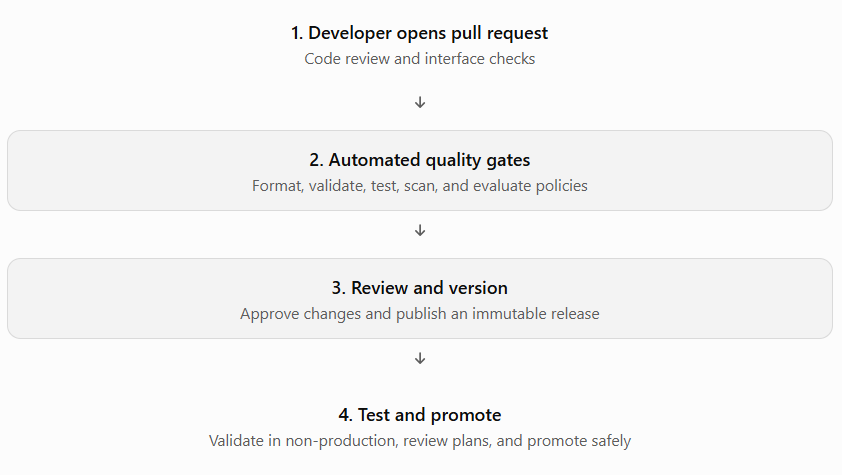
Importantly, publishing a module should not automatically apply changes to every consumer. A new module release and an infrastructure deployment are separate decisions. Teams should adopt the new version through their own review and deployment process.
Also, use secure pipeline identities, limit permissions, and protect release credentials. Separate permission to publish a module from permission to change production infrastructure whenever practical.
The result is a repeatable release process that supports many teams without sacrificing review quality or deployment safety.
The Configuration Trap: Avoid Turning Every Module Into a Giant Menu
As modules mature, teams often add more and more variables to accommodate every possible use case. Eventually, a simple module may contain dozens of boolean switches, nested objects, optional resource blocks, and special-case logic.
This creates a configuration trap. The module technically supports many scenarios, but callers struggle to understand which combinations work together. Testing also becomes harder because the number of possible configurations grows rapidly.
Instead, design around common supported use cases. Use a clear input for a meaningful choice, such as whether a supported feature is enabled. Use structured objects for settings that belong together, and keep related defaults consistent.
For example, a module might accept
variable "monitoring" {
  description = "Monitoring configuration."
  type = object({
    enabled        = bool
    retention_days = number
  })

  default = {
    enabled        = true
    retention_days = 30
  }
}
This is more understandable than separate variables with unclear names, especially when the settings work together. You can also validate allowed retention values or enforce different minimums for production through a suitable policy layer.
However, do not hide important operational behavior behind vague switches. Inputs such as magic_mode, advanced, or everything_enabled make configuration difficult to audit.
When two use cases require fundamentally different ownership, lifecycle, or security assumptions, separate modules may be cleaner than adding more conditional logic. Keep modules flexible enough for legitimate needs, but opinionated enough to guide callers toward supported designs.
Multi-Cloud at Enterprise Scale: Standardize the Experience, Not Every Provider Detail
Organizations increasingly use more than one cloud provider. They may run applications on AWS, data services on Azure, and analytics workloads on Google Cloud. Terraform can manage these environments, but module design becomes challenging when teams try to hide every provider difference behind one universal abstraction.
For example, a compute module that attempts to expose an identical interface for AWS EC2, Azure Virtual Machines, and Google Compute Engine may hide important differences in identity, networking, disk behavior, and lifecycle management.
Instead, standardize the developer experience while preserving provider-specific implementations. You might offer similarly named modules such as compute/aws, compute/azure, and compute/gcp. Each module can follow common organizational standards for tagging, logging, encryption, and ownership while exposing the provider-specific settings that matter.
A platform team can establish shared principles:
- Consistent naming and resource metadata.
- Approved identity and access patterns.
- Encryption and network-security requirements.
- Standard monitoring and logging expectations.
- Predictable input and output documentation.
- Consistent release and testing practices. However, do not force every provider to behave identically when its services differ. A shared interface is useful only if it simplifies real workflows without concealing operational trade-offs.
Multi-cloud module design should reduce cognitive overhead, not create a fictional lowest-common-denominator cloud. Build reusable provider-specific modules, then compose them through platform-level workflows where that abstraction provides genuine value.
Governance Without Gridlock: Give Platform Teams Standards and Developers Freedom
Enterprise module governance often fails in one of two ways. In the first, every team invents its own patterns, which creates security gaps and inconsistent operations. In the second, a central platform team controls every change, which slows delivery and frustrates application developers.
The better approach establishes a small set of mandatory guardrails while leaving teams free to choose within those boundaries. Platform engineers define approved module interfaces, security requirements, supported versions, and release practices. Application teams choose the appropriate modules and environment settings for their workloads.
For example, an organization may require all production databases to use encryption, approved backup policies, and private network access. The database module can implement those controls by default, while policy checks verify that consumers do not bypass them.
At the same time, teams can select instance sizes, workload-specific monitoring settings, or other permitted options without requesting a platform-team exception every time.
Create clear ownership for shared modules. Each module should have maintainers, an issue-reporting process, a release policy, and a support expectation. When a security issue appears, teams should know who can fix it and how the fix will reach consumers.
Finally, measure governance by outcomes rather than the number of approval steps. Good governance reduces dangerous choices and gives teams a faster path to compliant infrastructure. It should help developers move confidently, not turn every deployment into a bureaucratic exercise.
Observability for Infrastructure Code: Measure the Module Lifecycle
A module may be technically reusable while still causing operational problems. Perhaps consumers avoid upgrades, plans regularly contain unexpected replacements, or a shared module creates a high volume of support requests.
Therefore, measure module performance across its lifecycle. Useful indicators include adoption, release frequency, upgrade delay, test reliability, deployment failures, and the time required to provision a standard environment.
For example, if many teams remain on an old module version, investigate why. Perhaps the migration guide is unclear, the new release introduces breaking changes, or consumers fear unexpected infrastructure replacements. The correct response may be better documentation, more compatibility testing, or a safer rollout strategy.
You can track practical metrics such as.
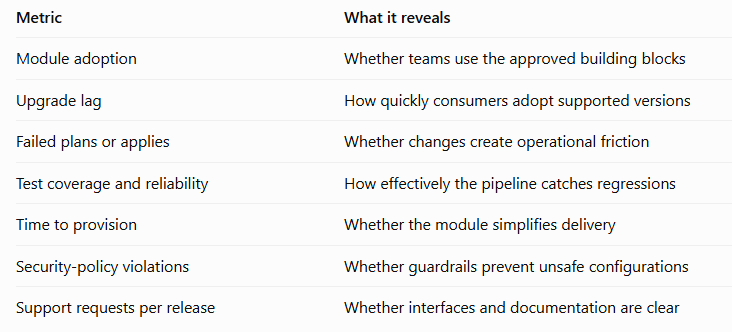
These metrics should support improvement rather than punish teams. A module used by critical production systems may reasonably change less frequently than a development-only module. Similarly, a high adoption rate does not automatically prove good design if consumers use the module only because organizational policy forces them to.
Review the data regularly and discuss recurring problems with both platform engineers and application teams. In the long run, a module ecosystem succeeds when it becomes easier to use, safer to upgrade, and cheaper to maintain.
A Practical Enterprise Blueprint: From First Module to Platform Standard
You do not need to redesign every Terraform repository at once. A phased rollout helps teams prove the value of reusable modules while avoiding an enormous migration project.
Start by identifying duplicated infrastructure that changes frequently or carries meaningful security risk. Networking, identity, storage, database configuration, and common application foundations often provide useful starting points. Choose a module that has a clear owner and enough reuse to justify the investment.
Next, define the module interface, security defaults, supported versions, and test strategy. Publish a first version and migrate one non-production workload. Observe the resulting plan, collect developer feedback, and fix confusing inputs or missing outputs before wider adoption.
Once the initial module works well, automate the release process and establish a documented path for consumer upgrades. Then repeat the approach for the next high-value capability.
A sample 90-day roadmap could look like this.
Days 1–30 Discover and standardize
Inventory duplicated configurations, choose a pilot module, define naming conventions, and establish security requirements and ownership.
Days 31–60 Build and prove
Implement the module, write documentation and tests, publish a version, and validate it with a non-production workload.
Days 61–90 Automate and expand
Introduce release automation, onboard additional consumers, measure adoption and upgrade friction, and refine the governance process.
Keep the first milestone small. A well-tested module used successfully by three teams is a better foundation than a large collection of half-documented modules that nobody trusts.
After the pilot, prioritize improvements based on real usage. Expand the registry, add integration tests, introduce automated policy enforcement, and create templates for common workload patterns as the organization becomes ready.
Common Terraform Module Mistakes That Sabotage Growth
Even experienced teams can create module ecosystems that become difficult to maintain. Fortunately, most problems can be avoided by recognizing them early.
Mistake 1: Building a module for every resource. This creates unnecessary abstraction and makes simple changes harder. Instead, group resources that share a meaningful responsibility or lifecycle.
Mistake 2: Creating one giant module for everything. An all-in-one module may combine networking, databases, compute, monitoring, and application configuration. As a result, changes become tightly coupled. Split capabilities where independent ownership and lifecycles justify the separation.
Mistake 3: Using unpinned module sources. A consumer that follows a moving branch may receive unexpected changes. Use published versions or stable source references and review upgrades deliberately.
Mistake 4: Ignoring backward compatibility. Changing an input or default can affect many environments. Follow a versioning policy, provide migration instructions, and test representative consumer plans.
Mistake 5: Treating documentation as optional. A module without examples, clear input descriptions, and known limitations forces every team to reverse-engineer the implementation. Generate documentation where possible and keep examples tested.
Mistake 6: Overusing conditional logic. Too many feature flags can create a module that is difficult to test and understand. Separate fundamentally different use cases instead of adding endless switches.
Mistake 7: Sharing state across unrelated teams. This creates unnecessary coupling and increases the impact of mistakes. Align state boundaries with ownership, lifecycle, and failure domains.
Mistake 8: Treating a successful plan as proof of safety. A valid plan can still expose services publicly, replace critical resources, or violate organizational policy. Combine plan review with testing, security analysis, and policy enforcement.
The lesson is simple: scaling Terraform modules requires engineering discipline, not merely a directory of reusable .tf files. Every abstraction should make the system easier to operate, understand, or secure.
Build Infrastructure Building Blocks, Not a Tower of Dependencies
Terraform modules can transform enterprise infrastructure from a collection of copied configurations into a consistent, maintainable platform. However, that transformation requires more than extracting repeated code into separate directories.
Start with clear responsibilities, compose small modules into useful solutions, and establish stable interfaces. Then add versioning, remote state boundaries, automated testing, secure defaults, and a reliable release process. Together, these patterns allow teams to reuse proven infrastructure without sacrificing independence.
At the same time, remember that the best module is not necessarily the most flexible or the most abstract. It is the one that solves a well-defined problem, guides developers toward safe decisions, and remains understandable as requirements evolve.
Most importantly, scale the module ecosystem according to real demand. Begin with a high-value use case, learn from actual consumers, and improve the design before expanding across the organization.
Your next step: Choose one infrastructure component that multiple teams currently copy and maintain separately. Turn it into a versioned, tested module, pilot it with one non-production workload, and measure whether it reduces duplication, improves security, and simplifies future changes.
That is how Terraform modules grow from convenient code reuse into a dependable enterprise infrastructure platform.
About the author
- DevOps Engineer with 20 years of experience designing scalable CI/CD pipelines, automating cloud infrastructure, and leading high-performing SRE teams. Expert in AWS, Kubernetes, Docker, and Terraform with a strong focus on reliability, security, and performance optimization.
Comments
Join the discussionNo comments yet. Be the first to comment.